
From Implementation to Measurable Impact: Getting More Value from AI
September 02, 2026

legal tech change management adoption artificial intelligence
In my previous article, I introduced the CLEAR Framework as a practical approach to AI adoption for legal teams. Now, let’s put that framework into action using a real-world example.
AI adoption isn’t just about selecting the right tool. It’s about operationalising AI within your legal department’s ecosystem, often by leveraging capabilities in tools you already have. And while many legal teams feel like AI should help solve challenges such as document search and knowledge access, they often struggle to identify the right approach to achieve that.
The issue isn’t a shortage of ideas or a lack of tools. More often, it’s the absence of a structured way to move from concept to impact, and that’s exactly what CLEAR is designed to solve.
One of the most common pitfalls in AI adoption is starting with tool selection before fully understanding the use case and whether the organisation is ready to support the tool. CLEAR reverses that sequence.
Let’s look at how this works in practice.
The Use Case: Document Search and Knowledge Access
Consider a legal team with a large volume of documents. The data exists, but finding the right information quickly is a constant challenge. Team members spend time searching, recreating work, or responding repeatedly to similar questions.
The team believes AI can help, but they’re not sure where to start. They want real, measurable impact and a quick win. Also, like most legal teams, they’re busy, so any solution needs to be practical, efficient, and adoptable.
Here’s how the team might apply the CLEAR Framework to address this use case.
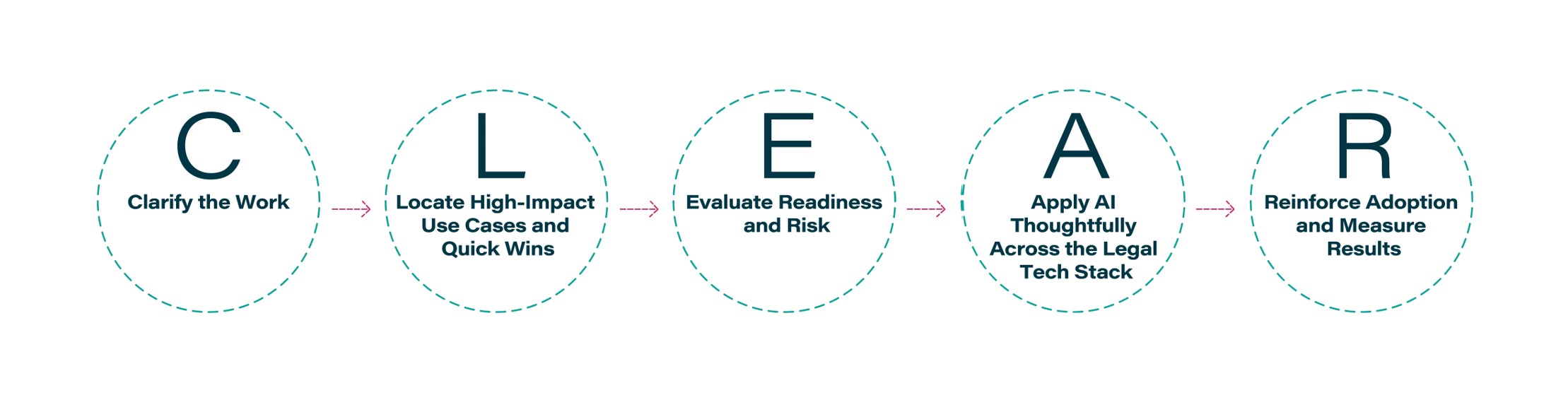
C – Clarify the Work
AI doesn’t start with tools. It starts with understanding the work and the opportunities. Before evaluating solutions, it’s critical to identify where time is spent today, where friction exists, and where the most meaningful opportunities for improvement lie.
Legal teams can use interviews or surveys to ask targeted questions and uncover use cases, like the one above. These questions can also help gather baseline data to define and measure success. Sample questions might include:
- Approximately how much of your time each week is spent on repeat, similar, or duplicative tasks?
- If you receive legal support requests, what type of support is requested most often?
- Which activities require the most significant amount of time synthesising, summarising, reviewing, or inputting information?
- What systems/tech do you use most often today to accomplish your work?
- If one part of your work could be meaningfully improved, what would it be and why?
These types of questions help surface patterns that point to real opportunities for AI to add value.
L – Locate Use Cases
Once teams begin this process, they often discover something important: they don’t lack ideas, they lack structure. Use cases often exist in silos or conversations, but they haven’t been gathered, evaluated, and prioritised in a consistent way. By documenting use cases and evaluating factors such as impact, effort, cost, and time to implement, teams can identify where to start. This ensures teams focus on use cases that create visible business outcomes rather than pursuing AI for its own sake.
As ideas are gathered, documented, and assessed, top use cases will start to surface. In the example below (a simplified illustration), two of the three ideas are related to search and knowledge access, and both can be implemented with relatively low effort, cost, and time, making them strong candidates for a quick win and initial prioritisation.
| Use Case Description | Supporting Data | Team(s) Impacted | Impact (once Implemented) | Effort to Implement | Cost to Implement | Time to Implement | Prioritise Initially? |
|---|---|---|---|---|---|---|---|
| Surface related, prior outside counsel memos/advice, compare and contrast guidance, and apply to facts of current matter | This is a pain point/need identified by 8 survey respondents (18%) | Litigation, Operations | Medium | Low | Low | Quick Win | Yes |
| Identify and surface existing materials that are similar or relevant to the current need | This is a pain point/need identified by 10 survey respondents (22%) | Litigation, Operations, Privacy, IP | Medium | Low | Low | Quick Win | Yes |
| Analyse all historical documents and generate proactive legal risk insights and recommendations across business uses by practice area and using a set template | This is a pain point/need identified by 4 survey respondents (9%) | GC, Compliance | High | High | Medium | 6–12 Months | No |
Example Use Case Documentation (simplified)
The most effective AI programs don’t start with the most sophisticated initiatives – they start with the most repeatable and practical ones. This approach supports quick wins, faster time to value, and stronger adoption. Once teams build confidence and momentum, they can expand into complex use cases more effectively.
E – Evaluate Readiness and Risk
This is where many AI initiatives begin to struggle. Legal teams often have extensive data, but it may not be structured or consistent enough to support high-quality AI outputs. Similarly, governance requirements, data sensitivity, and stakeholder alignment can introduce constraints that impact tool selection and implementation.
Just because an AI tool has certain capabilities doesn’t mean the organisation is ready to leverage them.
At this stage, teams should pause and confirm readiness for implementation by considering questions such as:
- Have foundational data challenges been addressed?
- Are any required integrations understood?
- Is there a plan for rollout, training, and change management?
A – Apply AI Thoughtfully
With prioritised use cases and a clear understanding of readiness, teams are in a much better position to evaluate and select solutions.
In many instances, meaningful value can be unlocked by applying AI within tools teams already use, such as document repositories, CLM systems, collaboration platforms, and email. These tools are often already embedded in daily workflows, which can significantly improve adoption and time to value.
For our document search and knowledge access use case, this means identifying where AI can most effectively support how work is already being done, such as surfacing key documents, summarising content, or helping users find relevant information more quickly.
Applying AI effectively depends on having the right data structures, workflows, and user guidance in place. Even for a relatively straightforward use case, there are several key activities required to ensure successful implementation and adoption. The example below highlights a simplified set of activities teams might complete as they prepare to apply AI to our use case.
| Sample Adoption Checklist | |
|---|---|
| Use Case: Document Search and Knowledge Access | |
| Category | Activity Description |
| Data and Structure | Standardise document storage locations and folder structures |
| Align/standardise metadata fields to support consistent search and filtering | |
| Identify and address duplicate, outdated, or inconsistent documents | |
| Tools and Integrations | Confirm where AI capabilities will be applied (i.e., which repositories, which collaboration tools, etc.) |
| Confirm system owners for integrations | |
| Review integration points between systems (e.g., SharePoint, email) | |
| Workflow and Usage | Define when and how team members should use AI for search and summarisation |
| Align AI outputs with existing legal workflows and review processes | |
| Adoption and Change Management | Provide targeted training on how to use AI for this specific use case |
| Establish clear guidelines for validation and appropriate use | |
| Create a feedback loop to capture user input and refine over time | |
Example Adoption Checklist (simplified)
These types of activities help ensure that AI is not only implemented but also integrated into how work actually gets done. This supports consistent use, builds trust, and ultimately drives meaningful value over time.
R – Reinforce Adoption and Measure Results
Adoption remains one of the most significant challenges across all technology initiatives, not just AI. Successful implementation and adoption require:
- Intentional stakeholder engagement
- Clear training and guidance for end users
- Defined feedback loops post-rollout
- Ongoing support after rollout
It’s also important to recognise that implementation is just one milestone, not the finish line. Value doesn’t come from simply launching a tool or enabling a feature. It also comes from strong adoption, sustained use, continuous improvement, and measurable outcomes over time. After all, if you’re not measuring, you’re experimenting – not transforming.
For our document search and knowledge access use case, this means defining what success looks like early and putting structure around how it will be tracked. For example, teams may want to understand how much time is saved when locating documents, whether duplicate work is reduced, or how frequently AI-assisted search and summarisation is being used.
To measure these outcomes effectively, successful teams:
- Establish baseline performance before implementation
- Define initial target outcomes and success thresholds
- Identify data sources (e.g., system usage data, surveys, user feedback)
- Assign clear owners who are responsible for tracking and reporting
- Set measurement and reporting periods to evaluate progress over time
With this structure in place, teams can track results consistently and use that data to refine their approach by adjusting workflows, addressing gaps, and reinforcing what’s working. In this way, AI adoption becomes an iterative process driven not just by implementation, but by measurable, sustained impact.
Conclusion
AI can help legal teams address challenges like document search and knowledge access, but it will be most successful when approached in a structured, intentional way.
The CLEAR Framework provides that structure. It shifts the focus from tools to the work itself, guiding teams through a structured, sequenced approach that prioritises understanding, readiness, and measurable outcomes.
Learn more about our AI Advisory Services