

A Practical Path to AI Adoption for Legal Teams: Introducing the CLEAR Framework
May 11, 2026

change management adoption legal technology artificial intelligence
AI has quickly become a standing agenda item for many law departments and law firms. Organisations are asking leaders what they are doing with AI, teams are seeing a steady stream of new tools, and there is growing pressure to ‘get started’ before falling behind.
At the same time, many legal organisations are understandably cautious. Questions about data privacy, accuracy, governance, and adoption loom large. The result is a familiar tension: real interest in AI’s potential paired with uncertainty about where to begin and how to proceed responsibly.
At Elevate, we have seen this challenge play out across legal teams. What we’ve observed repeatedly is that successful AI adoption rarely starts with selecting a tool. It starts with bringing structure and intention to the process. That is the motivation behind the CLEAR framework, a practical approach designed to help teams adopt AI in a structured, sustainable way.
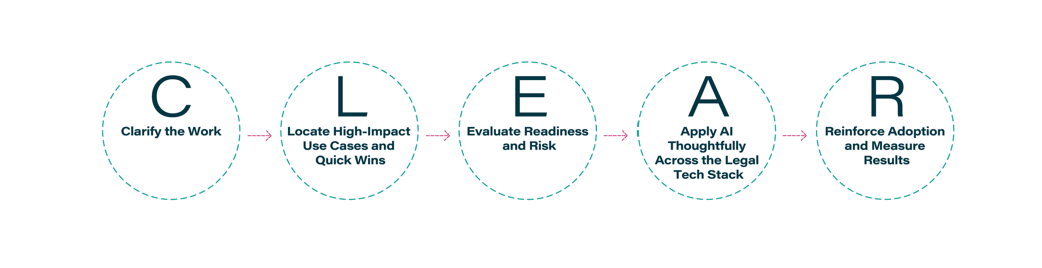
C – Clarify the Work
Effective AI adoption begins with the legal work itself. Rather than starting with implementation of a new AI tool, organisations benefit from looking closely at where volume, friction, risk, or cognitive load consistently show up across workflows.
Teams can clarify the work by reviewing use cases across the legal industry to understand where peers have applied AI successfully and where similar opportunities may exist for their own team. Conversations with legal team members can identify areas where AI can meaningfully improve how work gets done. Targeted learning about AI capabilities helps translate abstract pain points into actionable opportunities. Additional AI applications also tend to emerge organically over time as teams begin experimenting and rethinking how legal work happens day to day.
L – Locate High-Impact Use Cases and Quick Wins
After clarifying the work, teams should identify, document, and evaluate use cases systematically. Criteria such as potential impact, time to value, and the number of people affected help prioritise effectively.
When moving from evaluation to execution, legal teams often benefit from selecting an initial set of AI use cases that balance high-impact initiatives with quick wins. Quick wins demonstrate value early, support change management, and build confidence. High-impact initiatives establish a foundation for longer-term outcomes.
Teams can even leverage AI during this phase to analyse interview notes, summarise findings, and create materials that support tracking, prioritisation, and decision-making.
E – Evaluate Readiness and Risk
AI tool selection and adoption typically involve multiple stakeholders across the organisation, such as information governance, information security, IT, compliance, leadership, and legal teams. Successful AI initiatives identify and engage these stakeholders early while maintaining forward momentum.
This engagement is critical to assess requirements, data sensitivity, and organisational and industry governance standards. Different AI tools carry different risk profiles, particularly when connected to existing systems and data. Early readiness and risk assessment surface constraints and potential roadblocks upfront, helping teams avoid investing time evaluating AI tools that ultimately cannot meet organisational, security, procurement, or other requirements.
A – Apply AI Thoughtfully Across the Legal Tech Stack
Legal teams can unlock meaningful AI value by leveraging capabilities already embedded in tools teams use daily, such as CLM platforms, document management systems, SharePoint, intake tools, and reporting solutions. These tools already meet IT and procurement requirements, are user-friendly, and integrate directly into existing workflows. These factors improve adoption and time-to-value.
Applying AI thoughtfully, however, requires more than enabling features within existing tools. AI performs best when data is organised, structured, and consistently managed. Clean, well-structured data and harmonised processes significantly influence the quality and reliability of outputs across AI-enabled workflows. Maximising AI effectiveness often requires investment in data gathering and preparation, process standardisation, and foundational cleanup so AI can operate on stable inputs.
Additionally, as legal teams draw on insights from earlier CLEAR steps, they can evaluate where AI within existing tools provides sufficient capability and where gaps remain. The goal is thoughtful expansion of the legal tech stack, while ensuring AI investments remain grounded in practical needs and sustainable ways of working.
R – Reinforce Adoption and Measure Results
Tool selection and implementation are important milestones, not the finish line. Sustained AI value depends on trust, consistent use, and measurable outcomes that matter to the legal team and broader organisation. Successful AI programs define clear success metrics early, such as time saved, reduced rework, improved consistency, and risk mitigation.
Change management and training play a critical role at this stage. Legal teams need a clear understanding of how AI supports their work and how it fits into existing processes. Ongoing measurement enables organisations to refine their approach, adjust priorities, or sunset initiatives that fail to deliver meaningful value.
Looking Ahead
The CLEAR framework provides a structured path for legal teams to move past experimentation and noise towards disciplined, sustainable AI adoption. It shifts the focus from tools to how legal work is done, helping organisations adopt AI in a way that is practical, scalable, and aligned with real business needs.
Stay tuned as we explore each element of the CLEAR framework in greater depth, with practical guidance for applying it in real-world legal environments.
Learn more about our AI Advisory Services