

Expert-Led Automation That Actually Executes for Legal Teams
March 05, 2026

contracts legal operations artificial intelligence future of law
The legal AI market is evolving quickly. Every few weeks, a new platform promises sharper drafting, deeper reasoning, or more advanced analysis. The result of which is that many legal departments now operate with a growing collection of AI tools. Yet clarity is often missing. How do these tools connect? Where do they sit within established legal workflows? And how do they translate into measurable operational improvement?
Insight alone does not drive legal work forward. Legal teams must operate within the bounds of structured processes such as intake, contract review, negotiation, billing, and compliance. The real value emerges when AI strengthens those processes and accelerates execution across them. That is where agentic automation is beginning to reshape the landscape.
1. Execution as the Next Phase of Legal AI
The early wave of legal AI focused heavily on classification, analysis and pattern recognition: contract summaries, clause deviations, legal research, document interrogation. These capabilities have become increasingly sophisticated and widely adopted. Legal departments, however, function within interconnected workflows. A contract review triggers approvals. An invoice review impacts budgets. An intake request initiates triage and conflict checks. Intelligence sitting outside those systems has limited impact.
Agentic AI introduces a different model. Agents can reason, interpret intent and apply logic to make autonomous decisions, automatically triggering downstream actions. A deviation from a contract playbook can prompt a notification. An invoice anomaly can initiate a review workflow. A patent notice can generate deadline tracking and alert the responsible stakeholder. Execution becomes embedded within the system of record rather than layered on top of it. The AI operates where the legal work already lives.
2. The Differentiation: System of Record + Agentic AI + Expertise
Technology capability on its own rarely determines success. Sustainable impact depends on architecture and experience.
Elevate’s approach brings together three integrated components:
- The system of record provides structure, governance, auditability, and clean data
- Agentic automation enables orchestration and workflow execution across that structured environment
- Elevate’s legal and AI specialists shape how those agents are designed, prioritised, and refined
A decade of supporting over 700 legal teams has surfaced recurring patterns: invoice review backlogs, inconsistent contract negotiation outcomes, intake bottlenecks, compliance-tracking gaps and reporting inefficiencies. That real-world experience informs the automation templates already built and available with ELMA. Customers gain access to a growing library of practical, field-tested automations. Templates can be cloned and adapted quickly, reducing the time between identifying a pain point and deploying a working solution.
As Artificial Lawyer recently observed:
‘For a law company like Elevate, which works directly with in-house teams and already has an ELM system that it built itself, offering agents makes total sense. This brings it in line with the competition and the rapidly evolving expectations of in-house teams’.
The competitive landscape is evolving quickly. What differentiates outcomes is the ability to connect automation to structured systems and operational expertise.
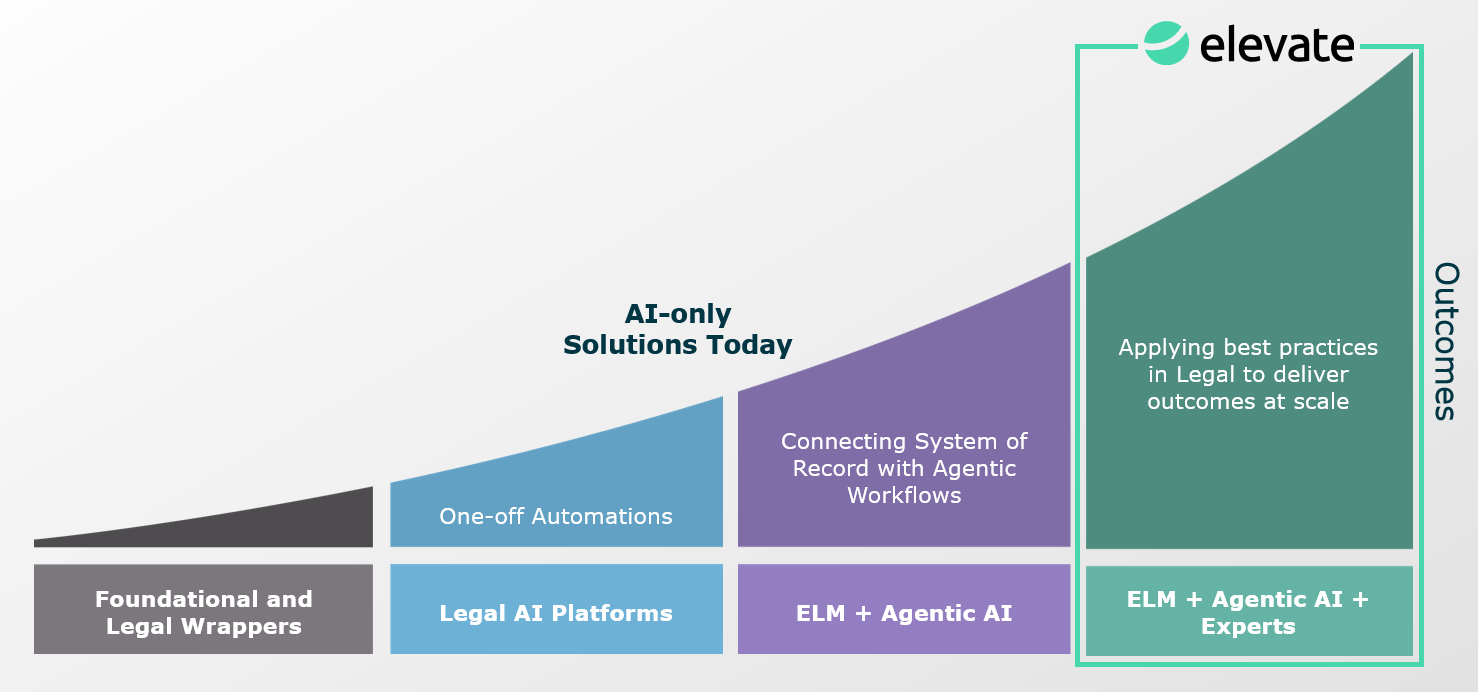
Elevate’s Legal and AI experts apply industry learnings to deliver targeted solutions.
3. Practical Use Cases Delivering Value Today
AI-powered automation is already supporting legal departments across multiple domains.
Contract management
- Natural language querying across entire contract repositories and internal knowledge bases
- Drafting agents generate first contract versions aligned with company templates
- Playbook-compliance agents review agreements against structured standards and flag deviations
- Automated creation of negotiation playbooks by converting gold-standard contracts into reusable frameworks
Workflow and intake
- Automate request capture and triage, supported by background conflict checks
- Analysis of legal records and emails to create structured timelines of key events, accelerating matter understanding
- Audio and video file transcription into fully searchable text
- Automated translation of legal documents while preserving formatting, making them immediately usable without additional rework
Spend management
- Invoice-intelligence agents that analyse billing data to identify trends and anomalies
- Invoice-status agents that send real-time updates and automate follow-ups via email to increase visibility and reduce manual chasing
Intellectual property
- Conversational agents assist with prior art and novelty analysis
- Automatic extraction of deadlines from patent office communications and generation of notifications to reduce risk across portfolios
Each of these applications removes friction from daily legal work. The common thread is operational follow-through. The system advances the workflow rather than pausing at analysis
4. Targeted Automation and Rapid Deployment
Legal departments rarely share identical structures, approval chains, or compliance requirements. Automation must reflect those realities and adapt as they change.
ELMA enables rapid creation of custom workflows and autonomous agents using plain-English prompts. With integrations to more than 200 third-party systems across finance, procurement, document management, and other enterprise platforms, it can connect to the tools legal teams use every day. Where no native connector exists, a guided connection builder supports rapid configuration. This makes highly targeted solutions possible, and fast. A specific reporting gap, a niche regulatory requirement, or a recurring approval bottleneck can be addressed with precision. Elevate’s team frequently collaborates with customers to design bespoke automations aligned with their operational priorities.
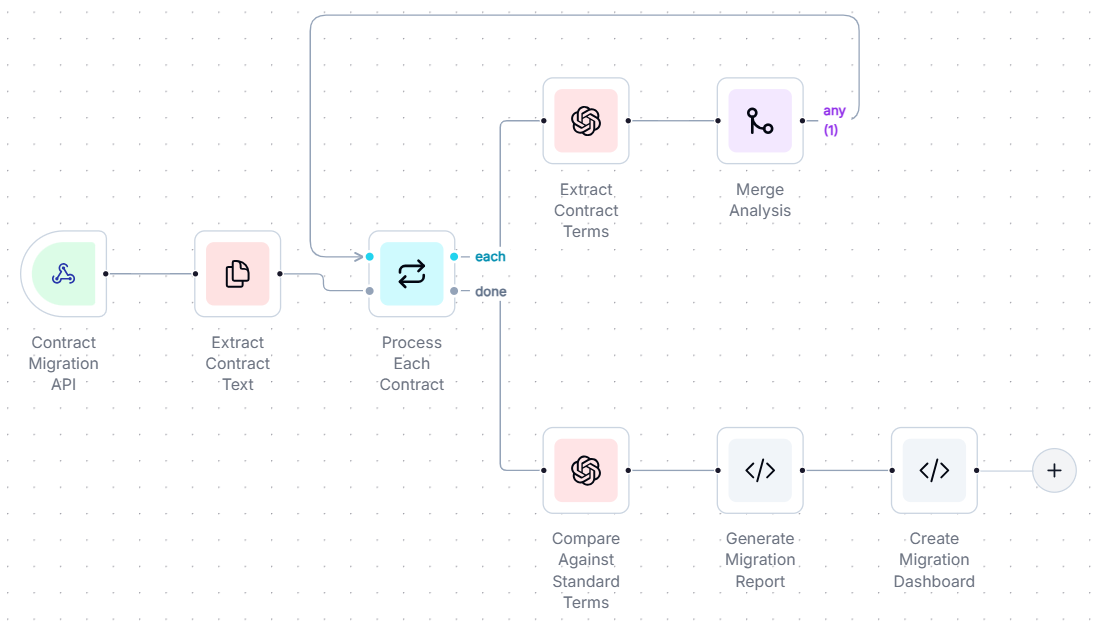
ELMA’s agentic automation builder creates workflows in minutes.
To demonstrate how quickly this can be achieved, Elevate has launched the ELMA Challenge. Organisations can submit a real use case, and within 10 days receive a working prototype and demonstration. The objective is to show practical capability in action rather than theoretical promise.
5. Agentic AI as the Orchestration Layer for 2026
As legal departments adopt an increasing mix of AI tools, coordination between these systems can become fragmented.
Agentic automation introduces an orchestration layer. Agents can draw data from across systems, initiate workflows, consolidate outputs, and ensure actions are recorded centrally within the legal system of record. As a result, oversight improves, governance strengthens and visibility increases. ELMA can serve as this unifying layer; a central hub connecting legal data, workflows, and AI capabilities across the organisation. Execution remains structured and auditable while benefiting from intelligent automation.
As 2026 unfolds, the defining advantage in legal AI will be the ability to combine structured data, agentic execution, and practical expertise into a cohesive operating model. When those elements align, AI becomes embedded within the legal function rather than sitting alongside it, providing a ‘living’ foundational environment that evolves alongside the department. As policies change, volumes increase, or new risks emerge, agents can be adapted without re-engineering core systems.
That’s true, scalable value right there.

ELMA can connect existing platforms and apply structured execution across legal workflows.
Tell us your specific operational pain point and we’ll work with you to build a prototype within 10 days for FREE.
Learn more about ELMA