

AI and the Legal Department of 2026: What’s Changing (and What’s Not)
February 16, 2026

contracts elm legal operations artificial intelligence future of law
The Legal AI Reset: How Expectations Have Shifted
The legal tech conversation has changed noticeably over the last year. In 2024 and early 2025, most teams were experimenting. They were testing generative AI tools, piloting point solutions, and exploring what might be possible. As 2026 begins, the questions have become more practical: Does AI work at scale, with our data set, and can it fit within our own operational systems and processes?
What hasn’t changed is the need for trust, accountability, and human oversight. Legal departments remain responsible for outcomes, and AI is increasingly viewed as decision support rather than decision-making. What has changed is the expectation that AI should be embedded into legal workflows, supporting billing review, contract analysis, and matter management as part of day-to-day work. This shift has placed enterprise legal management platforms at the centre of the legal AI conversation.
Where AI Is Already Delivering Value: Lessons from 2025
The most effective AI use cases are the ones that support existing operational processes and help teams to streamline traditional workflows.
Billing
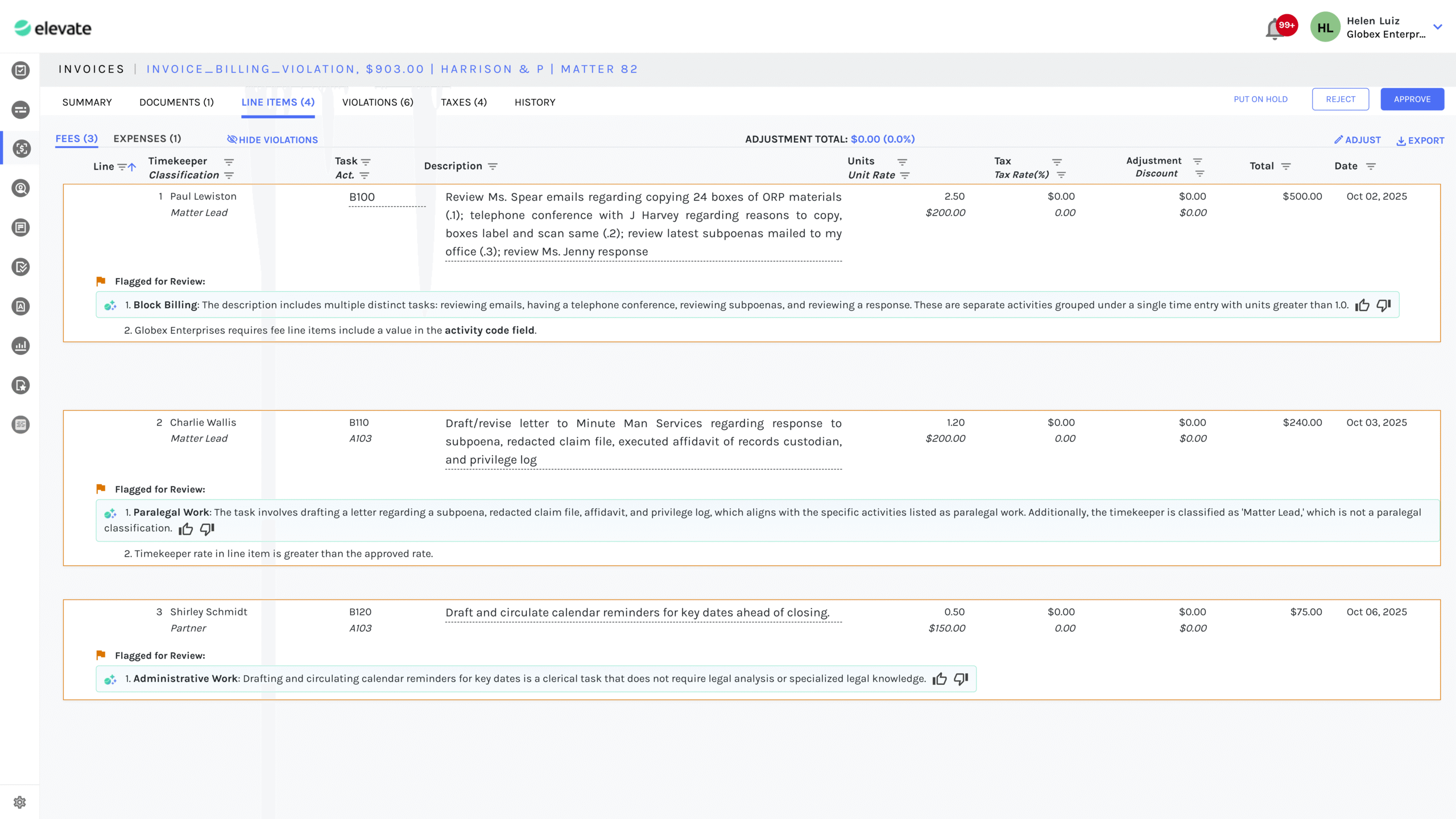
Automated invoice review has evolved beyond static rules and keyword checks. AI-powered OCG analysis now flags potential violations, inconsistencies, and unusual patterns across large volumes of invoices. This improves consistency and reduces manual review time. The tools help reviewers focus in on where their expertise and judgement are needed the most, filtering out the majority of invoices which DO comply with company guidelines, and saves considerable time.
Contracts
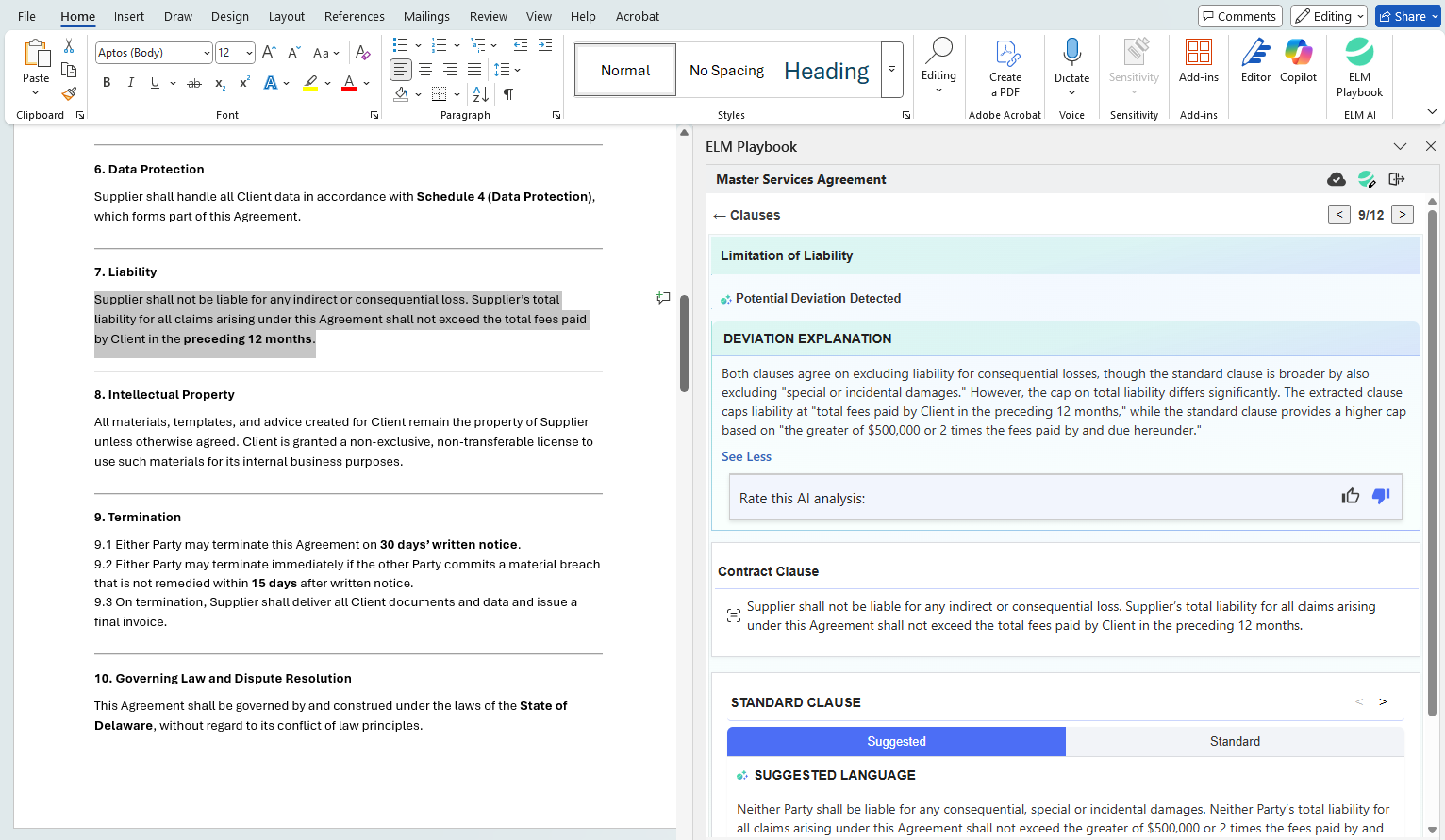
AI is providing genuine insight to assist the review process. Contract summarisation and clause deviation analysis are standard expectations. AI is also being used to suggest alternative wording and red-line amendments based on standard company positions.
Looking ahead, some agentic tools like Elevate’s own ELMA platform are already offering broader solutions such as AI-powered contract repository analysis and automated playbook generation. These tools help legal teams work more quickly while staying aligned with internal risk positions.
Workflow and Intake
Conversational AI is beginning to replace rigid forms. Chat-based assistance at the request or matter level allows users to interrogate documents, understand risk profiles, and surface similar past matters for guidance, all within the system where the work already lives. Together, these developments point to a theme: AI delivers the most value when it’s embedded into the legal system of record.
Legal Tech Trends Shaping 2026
Several broader trends are defining how legal teams approach AI in 2026. First, data has never been more important. Legal teams are consolidating the tools inside their core ELM/CLM platforms and using AI to interrogate real-world data, which improves decision-making through predictive analytics.
Second, transparency and auditability have become non-negotiable. Legal AI must show its reasoning. Flagging an invoice issue or contract deviation is only useful if the rationale is clearly presented to the end user. In addition, feedback loops on accuracy are critical to for improving AI models over time. This is where the human expertise layer can work with AI to increase efficiency and productivity.
Finally, automation is increasingly focusing on high-volume, repeatable tasks: billing review, intake triage, contractual amendments, and scheduled reporting. These are areas where AI can consistently reduce friction without introducing unacceptable risk, which allows legal experts to focus on areas requiring the highest scrutiny, where they can add the most value.
Aligning These Trends with the ELM Roadmap for 2026
These trends are directly shaping how modern ELM platforms are evolving.
Billing
AI is being trusted to take more decisive action when it identifies certain OCG violations, such as issues related to administrative work or specific hourly rate caps. New AI-powered ‘permanent reduction’ OCG rules allow recurring issues to be addressed systematically via non-negotiable, automatic adjustments. Invoices can now be processed automatically and will only be reviewed by a human if the adjustments are appealed.
Contracts
The focus is shifting from isolated contract review to repository-wide intelligence. Advanced AI-powered search across contract metadata and content allows legal teams to answer complex questions such as: ‘Show me all executed service contracts where we are exposed to x new regulation’. AI tools can provide a list of contracts meeting a certain criteria and link directly to the relevant sections within those documents, significantly speeding up review processes.
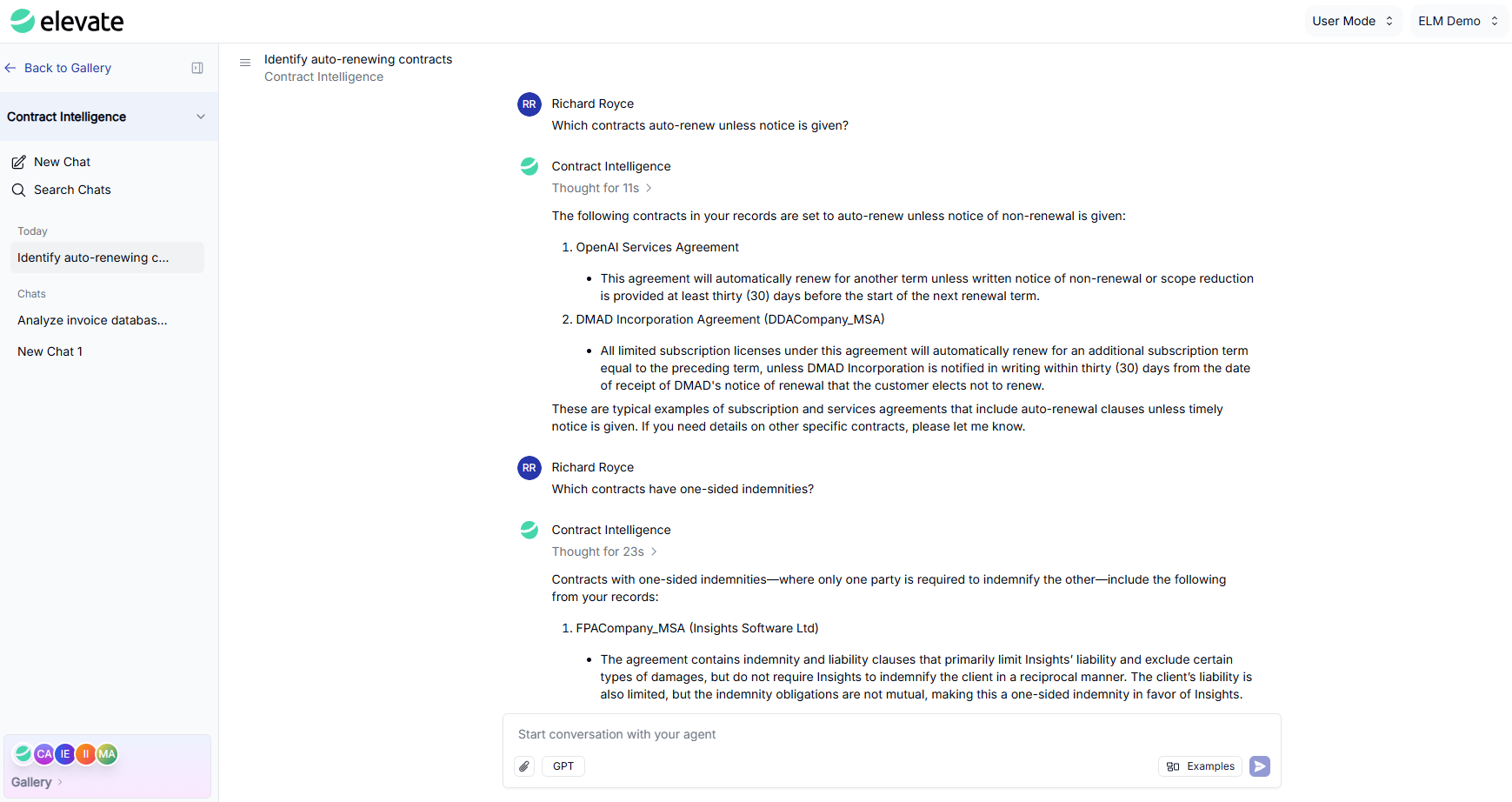
Support for contract amendment drafting, combined with more precise red-lining, reflects a move away from blunt automation toward targeted assistance that mirrors how lawyers naturally work. Agentic AI capabilities are also increasingly being used at a platform level to initiate and process new job requests. Conversational ‘Agents’ can be embedded into an ELM solution to support users across matters, contracts, and spend. They connect data sources and provide insights and updates on demand without relying on manual search and review.
Conclusion: ELM at the Heart of Legal AI in 2026
As we move further into 2026, the platforms that are having the greatest impact are those that embed intelligence into real-world legal processes, respect governance requirements, and reduce complexity rather than adding to it. At Elevate, we believe the future of legal tech is in building smarter operating systems for legal teams. These systems use AI to provide insight and consistency and deliver efficiencies across the entire legal function. Human expertise is still critical in this process, but the lens through which their expertise is used will be sharpened as teams focus in on where their judgement where it is needed the most.
In this landscape, enterprise legal management platforms sit at the centre as the foundational system of record upon which responsible legal AI is built.
If you want to learn more about how Elevate’s software is powering Legal Teams across the globe, book a demo call today.
Elevate’s ELMA Software