

Looking Back, Looking Forward: 2026 Edition
January 20, 2026

legal tech trends legal industry innovation artificial intelligence future of law
As we begin 2026, as in previous years, I pause to reflect on where we have been and where we are headed. I write about the continuing modernisation of the legal industry and the growing role of technology in how legal work gets done. ALSPs now represent a US$28 billion share of the legal market and continue to grow rapidly, reflecting the rising demand for integrated legal expertise, technology, and managed services. Nothing ‘alternative’ about that!
Looking Back
For Elevate, 2025 was another year of steady, profitable growth. We achieved record revenue of US$135 million, an increase of over 15%, and EBITDA of US$21 million, up 40% from 2024 (doubling EBITDA in the last two years). We welcomed more than 250 new customers. Our CSAT Net Promoter Score rose to 49, marking our fourth consecutive year of improvement and demonstrating our commitment to customer delight.
We expanded our capabilities, deepened customer relationships, and introduced new ways to work with us. The acquisition of Sagacious IP brought our customers a comprehensive IP solution, backed by deep expertise in patent strategy and portfolio management. With the Legadex acquisition, we strengthened our European presence and expanded our roster of AI-enabled legal services experts. We also welcomed Plume, a subscription-based service that provides flexible access to embedded legal experts within customer teams. With these additions, our global team grew to 2200+ Elevaters worldwide, and we added additional offices in Amsterdam and Japan.
We have consistently invested in AI-powered solutions for our customers long before they became mainstream. You may recall our acquisition of LexPredict seven years ago, which was our first step into AI, even before Transformers and LLMs. For example, long before Gen AI became mainstream, Elevate was embedding human-in-the-loop AI into our solutions, such as Contracts Insights.
One year on since we acquired Redgrave Data and its team of data scientists, including Jeremy Pickens, we have not only expanded our AI consulting capabilities but also built our own agentic AI platform. This allows us to help customers implement AI across legal ops, contracts, spend, entity management, discovery, intellectual property, and medical legal use cases. Now, legal teams have the ability to take their AI journey into their own hands with the Enterprise Legal Management Automation Agent (ELMAA).
Customers ask us to help them navigate their AI journey, deliver actual savings, and do things that were impossible or uneconomical before AI. We eschew theory and mere benchmarks – instead, we are focused on actual, demonstrable impact. Our customers ask us to connect them with like-minded travellers, so we host Elevate events in the US, the UK, and APAC to bring legal leaders together to share practical strategies for innovation, network, and learn from one another.
Market recognition reflected our commitment to customer success. We maintained Band 1 rankings across all eligible Chambers categories for the tenth consecutive year and received awards for innovation and employer and workplace excellence. In partnership with customers, we were awarded the ACC Value Champions Award with FedEx and Running Legal Like a Business Awards with Johnson & Johnson and PayPal. UKG was shortlisted by FT Innovative Lawyers, and we were nominated by LABJ in their Trailblazers Awards.
Looking Forward
Last year, I wrote about how legal ops professionals can ensure the dent they make in the universe actually matters, and about the intersection of AI and LegalTech. Implementing useful, reliable AI is now the clearest opportunity for legal ops to demonstrate that value.
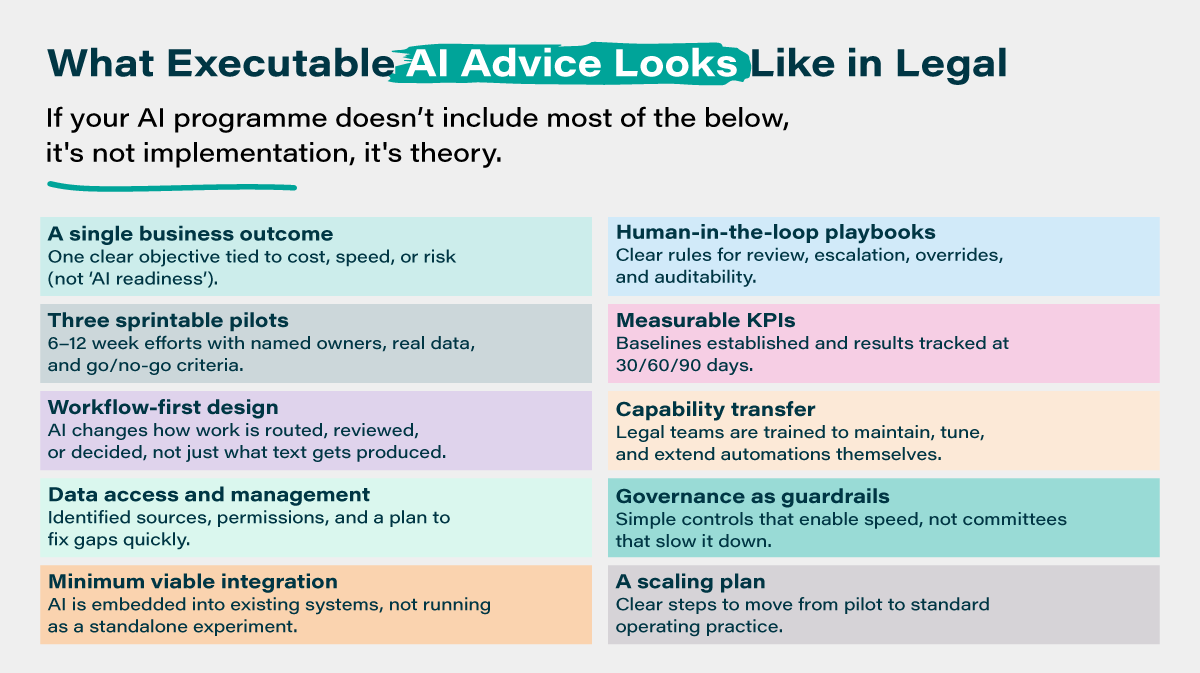
The legal industry has had no shortage of AI advice. What it has lacked is AI execution.
In 2026, the gap between organisations talking about AI and those benefiting from it will widen dramatically. The winners will not be the teams with the boldest vision decks or the most pilots. They will be the ones who figured out, often unglamorously, how to make AI work inside real legal operations.
The End of AI Theatre
Consulting firms have helped legal leaders understand why AI matters. But too much of that advice stops at strategy, governance, and ‘what others are doing.’ The result is a familiar pattern: months of planning, polished decks, and carefully worded policies, followed by pilots that never scale and tools that quietly fade from daily use.
What’s missing is not vision or caution. It’s an executable path.
Legal teams don’t need more use-case inventories or steering committees. They need practical, owned ways to embed AI into workflows, measure outcomes, and build internal capability. Strategy without execution doesn’t de-risk AI; it simply delays value and guarantees disappointment.
Software Without a Path to Impact
AI software vendors offer compelling features, including generative drafting and research tools, collaborative workspaces, portals, and integrations with familiar interfaces. That’s useful, up to a point.
But most of these products are horizontal platforms, not workflow engines. They aim to augment lawyer productivity across broad categories (research, drafting, review) while stopping short of the harder work: aligning with company or law firm-specific data, risk models, and decision protocols.
More importantly, they rarely come with a capability-building path.
What typically happens is predictable. A legal team buys a licence, spins up a few pilots, sees incremental wins, and then hits a plateau as the limits of one-size-fits-all software become clear. Without workflow integration or internal technical capability, the tool becomes shelfware. That dynamic fuels churn and frustration, not transformation.
The real differentiation will go not to the best software, but to the teams and partners who translate software into operational muscle, embedding AI into data, workflows, governance, and performance metrics so value sticks and compounds.
The real question legal leaders now face is simple: ‘How do we operationalise AI to produce durable, repeatable business impact?’
AI Moves Out of the Lab and Into the Work
In 2026, serious legal teams will stop ‘deploying AI software’ and start embedding it directly into how work flows through the department.
That means AI that will:
- Triage intake and route work instead of generating more content to review, and
- Flag risk and cost drivers early, not once a matter is over.
This is not about copilots or clever prompts. It is about rewiring the legal operating model so decisions happen faster, work is matched to the right level of expertise, and data improves with every interaction.
Human-in-the-Loop Is a Feature, Not a Bug
The idea that AI creates value by removing lawyers from the loop is a category error.
In legal, the highest returns come from combining AI with human judgment, not trying to replace it. The most effective teams will use AI to:
- Eliminate low-value review and routing work
- Surface better options, earlier
- Focus senior expertise where it actually matters
In practice, legal teams are increasingly designing workflows, training models, and refining automations themselves. AI becomes infrastructure, not magic.
Legal ops teams that treat lawyers as passive ‘end users’ will struggle to get traction. Those who empower legal teams to own their AI use will compound value over time.
Results That Matter Will Be Essential
The AI conversation is shifting from cost to consequence. In 2026, legal leaders will stop asking: ‘What does this AI cost?’ And start asking: ‘What does this change?’
Cycle time. External spend. Risk exposure. Headcount growth. If AI does not move at least one of these needles in a measurable way, it will not survive budget season.
This is where hype collapses, and where integrated, expert-led AI proves its worth.
Law Firms Will Be Challenged
Clients will no longer be impressed that firms say they ‘use AI’. They will expect firms to price, staff, and deliver differently because of it. Efficiency gains that are invisible to clients will be challenged. AI that does not change the economics of legal service delivery will be treated as irrelevant.
What We Believe at Elevate
At Elevate, we have little interest in AI narratives. We focus on implementation, ownership, and outcomes:
- AI embedded directly into legal workflows
- Legal teams empowered to build and evolve their own automations
- Deep expertise applied where AI alone is insufficient
Making legal teams ‘AI-enabled’ is table stakes. What matters is whether they can operate differently because of it. We help them do work they could not do before, or could not do economically, without it.
By the end of 2026, AI will no longer be discretionary; it will be a test of whether the function can truly support the business going forward.
Conclusion
Elevate is not just a law firm, a consulting firm, an ALSP, an AI company, or a legaltech company. As a law company, though, we are all of the above. We are expert-led, AI-software powered, and driving innovation in the modern practice of law.
Our customers have moved beyond ‘The Art of the Possible’ and are actually achieving real, tangible results with AI. Just as we don’t run around telling customers ‘Elevate is internet-powered’, we don’t advertise ‘Elevate is AI-powered’. There’s simply the expectation that AI is woven into our innovative solutions – and that’s what we deliver.
Thank you to our Elevate colleagues, customers, partners, and friends for your collaboration and trust this past year and in the future.
Back to Expertise