

How to Turn Your Contracts Into an Ongoing Source of Business Intelligence
July 15, 2026

contracts elm artificial intelligence future of law
Are Your Contracts Working Hard Enough?
Most organisations are sitting on thousands of contracts containing valuable commercial, operational and risk intelligence. Yet once agreements are signed, much of that information becomes difficult to access, analyse, or act upon. The result can be missed obligations, delayed decision-making and untapped business value.
Legal teams invest significant time negotiating commercial terms, managing approvals and securing signatures, yet once an agreement has been executed, it often disappears into a document repository until somebody needs to find it again.
That approach no longer reflects the expectations placed on modern legal teams.
The most effective legal teams are using their contracts as an ongoing source of business intelligence; providing visibility into obligations, supporting faster decision-making, identifying risk and helping the organisation respond to change with confidence.
That’s why modern contract management is about more than creating and storing agreements. It’s about ensuring every contract continues to deliver value throughout its lifecycle.
The AI-Powered Contract Lifecycle
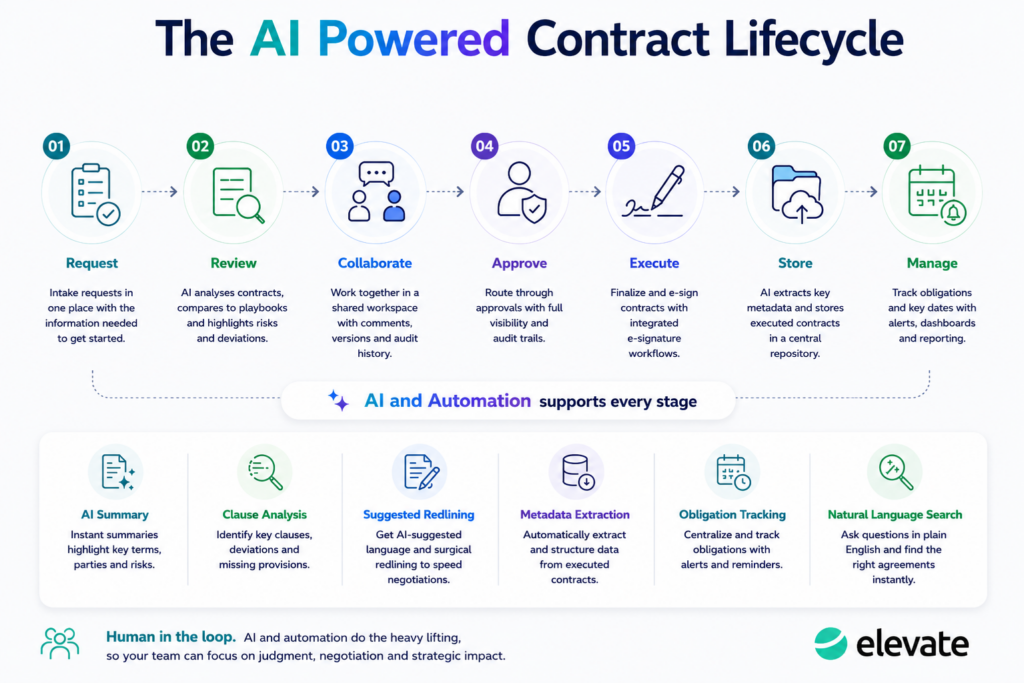
The modern contract lifecycle: AI and automation help legal teams streamline processes, improve governance and unlock contract intelligence at every stage.
Every contract follows a familiar process, as outlined in the above diagram. What has changed is what legal teams now expect from the technology supporting that journey.
AI-assisted review, workflow automation, integrated approval processes, electronic signatures, and intelligent search have quickly become essential and impactful capabilities of a modern Contract Lifecycle Management (CLM) platform. These technologies don’t replace legal expertise, but they do remove repetitive work, improve consistency and make valuable contract information available long after an agreement has been signed.
Better Starts Lead to Better Outcomes
Many contract delays occur before legal review has even begun. Requests arrive through email, Teams message, or hallway conversations, often missing the information needed to begin work. Lawyers spend valuable time chasing basic details before they can focus on the legal issues at hand.
Structured intake management changes that.
By enabling business users to submit requests through configurable forms that capture the right information from the outset, work can be prioritised, assigned, and tracked quickly, through consistent workflows. Stakeholders gain visibility into progress, while legal teams spend less time on administration and more time providing legal advice.
Once drafting or review begins, the focus shifts to where lawyers already work every day: Microsoft Word. Rather than switching between multiple systems, reviewers can access AI-powered playbooks directly within the ELM Word plugin. Contracts are automatically analysed against organisation-specific playbooks, key clauses are identified, deviations from preferred positions are highlighted and approved fallback language is presented alongside the document.
One particularly valuable capability is surgical redlining.
AI can propose targeted amendments to individual clauses, preserving negotiated language while generating precise tracked changes directly within the document. The technology streamlines the drafting process by improving consistency and reducing manual effort, while lawyers remain firmly in control of every suggested edit.
Governance Without Becoming a Bottleneck
Contract negotiations rarely involve just two people.
Commercial stakeholders, procurement, finance and legal all need visibility, while approvals often depend on contract value, risk profile, or business unit. Managing that process through email quickly becomes difficult and time-consuming.
ELM brings collaboration, governance, and execution together through configurable approval workflows. Contracts are automatically routed to the appropriate reviewers and approvers based on organisational policies, creating a complete audit trail while reducing unnecessary manual coordination.
Once approvals are complete, integrated electronic signature workflows allow agreements to move seamlessly into execution without leaving the platform. Every comment, approval, and document version remains connected to the contract record, making it easy to understand and track how each agreement reached completion.
The result is a process that feels simpler for the business while providing legal teams greater visibility, improved control, and stronger governance.
The Signature Isn’t the Finish Line
Too often, a signed contract marks the end of active engagement with an agreement. In reality, that’s when organisations begin relying on the information it contains.
Business teams routinely need answers to questions such as:
- Which supplier contracts are due for renewal in the next six months?
- Which customer agreements contain a particular liability provision?
- Which contracts may be affected by a regulatory change?
- What obligations are coming due next quarter?
- Which vendors represent the highest concentration of contractual risk?
Traditionally, answering those questions meant searching folders, opening documents one by one, and manually compiling spreadsheets. Modern contract management works differently. With ELM, executed contracts are automatically stored within a central repository where AI extracts key metadata, including parties, dates, obligations, and commercial terms. Existing contract repositories can also be imported in bulk, allowing organisations to unlock value from existing agreements, rather than manually recreating records.
Perhaps more importantly, that information becomes immediately accessible. Users can search their contract repository using plain English, rather than having to remember filenames or metadata fields. AI-powered search quickly surfaces relevant agreements, generates contract summaries, and helps users locate specific clauses or commercial terms within seconds.
Combined with automated obligation tracking, relationship mapping between agreements, dashboards and reporting, contracts become a living source of operational insight, with structured information available to the right stakeholders whenever it’s needed.
Turning Insight Into Action
The ability to search, analyse, and understand your contract portfolio is only part of the story.
Increasingly, legal teams are expected to act on that information. Whether responding to a regulatory change, integrating contracts following an acquisition, or implementing updated company policies, many initiatives require coordinated action across hundreds, or even thousands, of agreements.
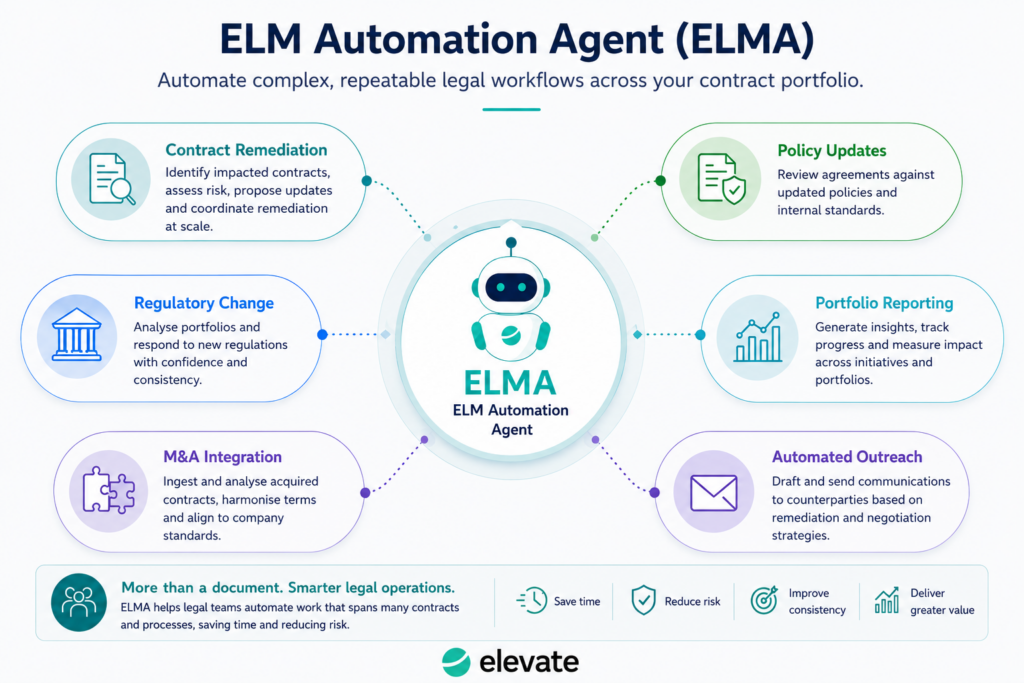
ELMA helps legal teams turn contract insights into action by coordinating large-scale remediation and compliance initiatives across contract portfolios.
This is where ELM Automation Agent (ELMA) extends the broader ELM ecosystem. Rather than focusing on individual contracts, ELMA helps legal teams orchestrate complex, repeatable legal workflows across entire contract portfolios.
Contract remediation provides a good example.
Instead of manually identifying affected agreements, assigning work, tracking progress, and coordinating updates across spreadsheets, ELMA can help analyse the portfolio, identify contracts requiring attention, support prioritisation, and coordinate the remediation process while keeping legal professionals firmly in control of critical decisions.
The greatest benefit emerges when these activities become repeatable. Organisations can establish consistent workflows for recurring legal programmes, reducing manual effort each time the process is performed.
Unlocking the Value in Every Contract
Contracts have always contained valuable business information. What’s changed is our ability to organise it, understand it, and put it to work.
When contract information is structured, searchable, and connected to the right workflows, agreements become far more than documents stored in a repository. They become reliable and valuable assets for the business that help legal teams respond more quickly, reduce manual effort, and support better commercial decisions across the organisation.
AI and automation are making that increasingly achievable, whether by assisting lawyers during contract review, simplifying approvals, surfacing answers through natural language search, or orchestrating portfolio-wide legal initiatives. Throughout that evolution, one principle remains unchanged: technology delivers its greatest value when it supports legal professionals rather than replacing them.
Keeping the human in the loop enables organisations to benefit from greater efficiency while retaining the judgement, context, and commercial understanding that experienced legal professionals bring to every important decision. Ready to unleash the power of your contracts?
Book an ELM demonstration and discover how AI-powered contract management can help your legal team unlock more value from every agreement.
Learn more about our Contracts Services