

From Idle Licences to Daily Use: A Three-Level Playbook for Legal AI Adoption
July 09, 2026

change management Consulting legal operations artificial intelligence
Most legal AI tools do not fail because of the technology. Across legal teams, a significant share of licences sit idle after the initial rollout. The pattern is predictable and avoidable. The encouraging part is this: adoption is no mystery. The teams getting it right follow a clear, repeatable playbook.
The problem
When General Counsel look honestly at their AI usage data, weekly active use of purchased licences typically sits between 30% and 40%, in line with independent analyses of enterprise Copilot rollouts. The curve follows a predictable pattern: a peak in week one after the launch, a dip by week two, a small revival around the training session in week three, and by month three, a quiet plateau held up by the same small group of early adopters.
Most General Counsel will recognise this curve immediately. In its 2025 State of AI report, McKinsey found that 78% of organisations use AI in at least one business function, while only a small proportion have successfully scaled AI beyond pilot projects to drive significant organisational transformation. BCG’s Build for the Future research shows that 5% of organisations are already capturing AI value at scale, with a clear playbook the rest of the market can follow. In the legal sector specifically, recent Law360 research shows that 70% of attorneys now use AI at least weekly while only 21% of firms have rolled it out organisation-wide.
Individual experimentation is widespread. Institutional adoption is not (yet). The playbook below focuses on closing that gap.
The three-part adoption playbook
Three levers consistently determine whether a legal AI tool gains traction: who champions it, how people learn it, and where it lives in the workflow. Pull all three deliberately, and adoption climbs sharply. Each lever stands on its own, and each can be pulled this week.
Across the legal teams we work with, these three levers consistently separate pilot programmes from scaled adoption.
1. Pick influence over enthusiasm: appoint the right champions
The single biggest predictor of team-level adoption is a credible internal champion. The most effective champions are not always the most enthusiastic early adopters. They are the most influential lawyers on the team, whose habits colleagues naturally follow.
What to do instead:
- Identify the most influential lawyer in each team. This is the person colleagues already approach with questions, whose habits others quietly copy.
- Offer them the champion role explicitly, with four hours per week of formally protected time. If it is not visible and protected, it will not happen.
- Give the champion three concrete responsibilities: act as first-line support for the team, collect feedback for the vendor or internal owner, and run the weekly office hour (see lever 2).
- Measure their impact with one number, weekly active users in their team, and review it monthly.
Teams with a credible champion typically reach 70% adoption within three months. This result is genuinely within reach, on the same tool, with the same budget and the same training that most teams already have in place.
2. Replace training events with training habits
A single ninety-minute training session is easy to organise, but rarely produces lasting adoption on its own. Research by BCG in its AI at Work 2025 study found that only 36% of employees feel adequately trained in AI use, which means there is a clear and practical opportunity to lift adoption simply by changing how training is delivered.
What to do instead:
- Replace the next large training session with one short kick-off, followed by six weekly office hours of 30 minutes each. Schedule all six up front.
- Run office hours without slides or a fixed agenda. The champion or a vendor expert is available; lawyers bring questions that arise in their day-to-day work.
- Add a monthly peer demo, where two lawyers each spend ten minutes showing how they used the tool in real work. Peer demos are more persuasive than vendor demos because they come from someone doing the same job.
- Capture recurring questions in a short, living FAQ, owned by the champion rather than by a project team.
The mechanism that works here is learning in the flow of work, alongside the moments people need it. Office hours and peer demos turn AI use into a weekly habit instead of a quarterly event.
3. Engineer friction out of the workflow
AI tools deliver the most value when they sit inside the work, rather than next to it. BCG’s research on AI value creation shows that the organisations capturing real value are those that reshape processes around the technology, and this is a step every legal team can take in measured stages.
What to do instead:
- Apply the three-click rule. If a lawyer needs more than three clicks to reach the AI, most will not use it. Map current AI tools against this rule and flag the ones that fail.
- Prioritise three integrations:
(a) a Word plugin so AI assistance is available inside the document
(b) a CLM or matter-management integration so review starts automatically on intake
(c) an Outlook button to eliminate copy-paste workflows - Open the conversation early with IT and the vendor. Integrations take effort and investment, and they are frequently the difference between 30% and 70% adoption, which makes the business case straightforward.
- Remove tools that cannot be integrated. A tool nobody uses is more expensive than no tool at all.
Your first week: five concrete actions
For teams that want to start immediately, here is a one-week plan that requires no new budget or project approval:
- Monday: pull the usage data for the most important AI tool currently deployed. Look at weekly active users, not licence count. That single number gives a clear starting point.
- Tuesday: identify a champion per team based on influence rather than enthusiasm. Have a fifteen-minute conversation with each one to confirm interest.
- Wednesday: block the first six weekly office hours in the calendar and send invitations. Commit to all six upfront.
- Thursday: rebalance the People, Process, Technology mix. Most organisations spend around 80% of their AI budget on technology, 15% on process and only 5% on people, while adoption lives almost entirely on the people side. This imbalance is well documented: organisations that capture value from AI invest far more in people and process, while most still over-invest in technology. Map your current spend against these three categories and identify one concrete shift you can make this quarter towards people and process, such as funding the champion time or the office hours from existing budget.
- Friday: list every AI tool in use and apply the three-click rule. Pick the tool with the most friction and open the integration conversation with IT or the vendor the following week.
A simple scorecard to track progress
Adoption is easier to sustain when it is measured. These four metrics, reviewed monthly, are enough:
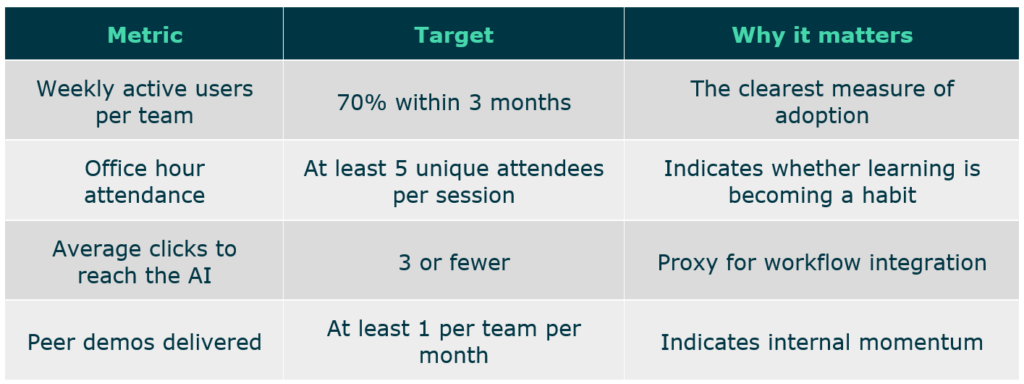
If three of the four are on target, adoption is progressing. If two or more need attention, return to the corresponding lever in the playbook and adjust.
The bottom line
The licence graveyard is a solvable problem, and the solution sits with the people around the technology rather than the technology itself. Put the right champions in place, turn learning into a weekly habit, and bring the tool into the workflow. Pull those three levers deliberately, measure the four metrics that matter, and weekly active use moves quickly past the familiar 30% to 40% plateau. The levers are identified and the system is proven. Every legal team already has its hands on them. All that is left is to pull. Start this week.
For legal teams looking to accelerate adoption, Elevate’s Consulting team helps organisations align people, process and technology to realise value from AI investments.
Learn more about our Law firm consulting Services